Last updated: February 19, 2026
Switching to a variable-speed pump is the single most impactful energy upgrade you can make for your pool. It can cut pump energy use by 50–90% compared to a traditional single-speed model [1][4]. But the pump is just the starting point. When you combine it with an efficient heater, LED lighting, and automation, you’re looking at hundreds (sometimes over a thousand) dollars saved per year on electricity alone. This guide breaks down every major energy-efficient pool equipment upgrade available in 2026, with real numbers on costs, savings, and payback timelines so you can make smart decisions for your home.
Key Takeaways
- Variable-speed pumps reduce energy consumption by 50–90% and are now required by federal efficiency standards for new installations [1][7].
- LED pool lights use up to 85% less energy than traditional incandescent or halogen bulbs and last far longer.
- Pool automation systems can save 10–30% on total pool operating costs by scheduling equipment to run only when needed.
- Efficient heaters (especially heat pumps) deliver 3–7 times more heat energy per dollar compared to standard gas heaters.
- Bundling upgrades together often qualifies for utility rebates and accelerates your return on investment.
Quick Answer
If you own a pool and want to lower your energy bills, start with a variable-speed pump — it’s the biggest single savings opportunity, often paying for itself within 2–3 years [5]. Then layer on LED lighting, a high-efficiency heater, and an automation controller. Together, these upgrades can cut your total pool energy costs by 50–70%, and many local utilities offer rebates that reduce your upfront investment.
Why Are Variable-Speed Pumps the Best Energy Upgrade for Your Pool?
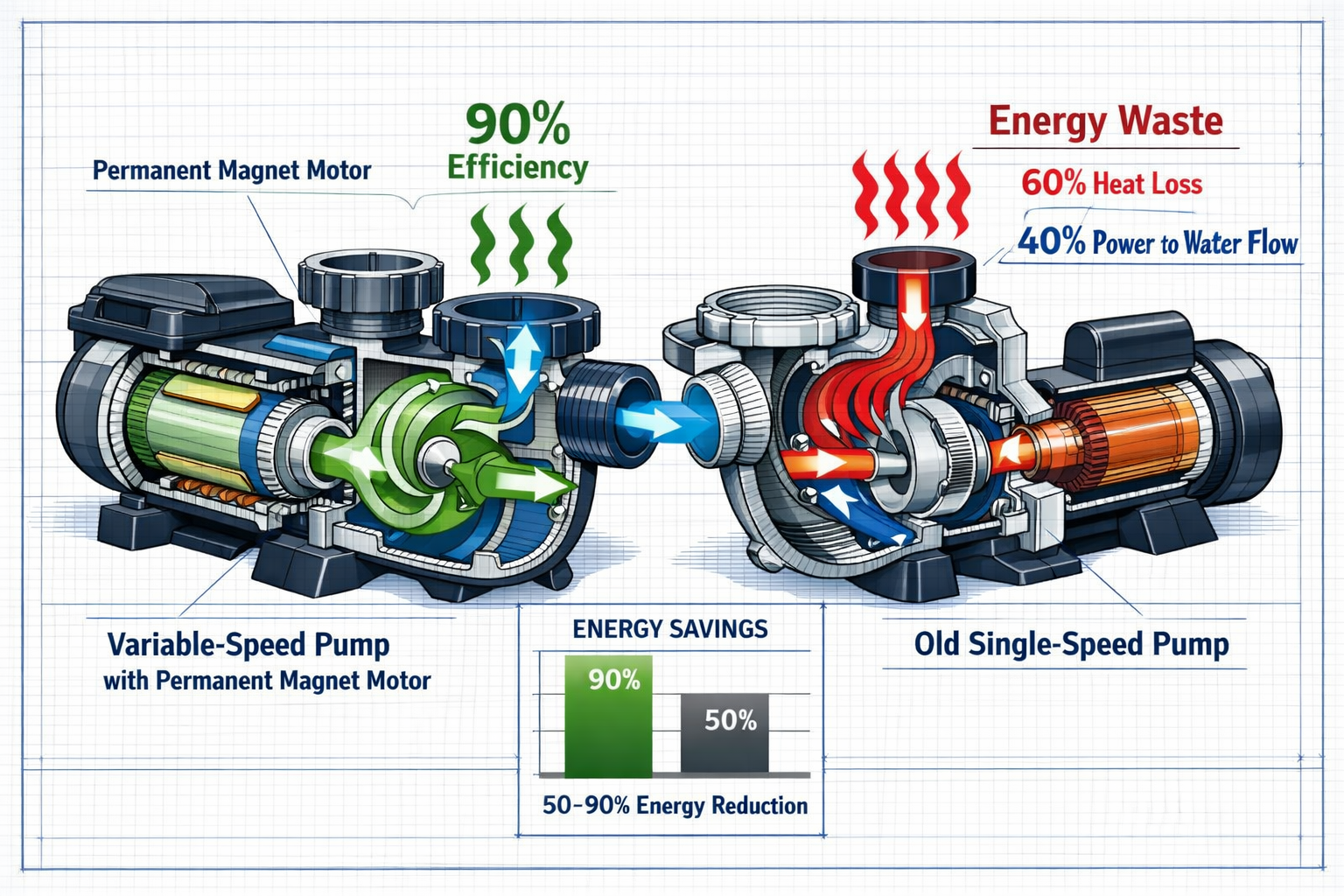
Variable-speed pumps save so much energy because of a physics principle called the Pump Affinity Law: when you reduce pump speed by half, energy consumption drops by roughly 87% [1]. That’s not a typo. Small reductions in flow rate result in significant reductions in power use.
Here’s why this matters for you as a pool owner:
- Single-speed pumps run at full blast continuously, typically drawing 1,500–2,500 watts. They push far more water than your pool actually needs for most tasks.
- Variable-speed pumps use permanent magnet motors (PMMs) that achieve about 90% efficiency, compared to 30–70% for traditional induction motors [1].
- Running your pump at a lower speed for longer hours actually filters your water better while using a fraction of the electricity.
A real-world example: At California’s average electricity rate of about 34.26 cents per kWh, switching from a single-speed to a variable-speed pump saves approximately 3,796 kWh per year, or roughly $1,300 annually [1]. Even in areas with lower electricity rates, annual savings of $500–$800 are common.
What about the 2021 DOE regulation?
Since 2021, the U.S. Department of Energy has required all new pool filtration pumps to meet minimum efficiency standards, making variable-speed pumps the default for new installations [7]. If your pool still has an old single-speed pump, it’s running on borrowed time—and costing you money every day it runs.
Common mistake: Some homeowners buy a variable-speed pump but then set it to run at maximum speed all the time, negating the savings. You need to learn how to program your variable-speed pump properly with the right speed schedules for filtration, cleaning, and water features.
If the budget is tight, dual-speed pumps offer a middle-ground option, though their savings are significantly less than those of true variable-speed models [7]. Choose a variable-speed pump if you plan to stay in your home for more than two years — the payback math works strongly in your favor.
For a deeper comparison of specific models, check out our review of the Pentair IntelliFlo3 VSF pump and our guide to Hayward variable-speed pumps.
How Do Efficient Pool Heaters Compare, and Which One Should You Choose?
If you heat your pool, the heater is likely your second-largest energy expense after the pump. Choosing the right heater type depends on your climate, how often you swim, and whether you have natural gas available.
Heater types at a glance
| Heater Type | Energy Source | Efficiency | Best For | Typical Cost Range |
|---|---|---|---|---|
| Heat Pump | Electricity (ambient air) | 300–700% (COP 3–7) | Year-round heating in mild climates | $2,500–$5,500 installed |
| Gas Heater | Natural gas or propane | 80–95% | Quick heating, cold climates, occasional use | $1,500–$4,000 installed |
| Solar Heater | Sunlight | Free fuel (after install) | Extending swim season in sunny regions | $2,000–$6,000 installed |
Decision rule: Choose a heat pump if you live in an area where temperatures rarely drop below 45°F, and you want to heat your pool regularly. Heat pumps pull warmth from the surrounding air and transfer it to your pool water, delivering 3–7 units of heat for every 1 unit of electricity consumed. That’s dramatically cheaper to operate than a gas heater.
Choose a gas heater if you only heat your pool occasionally (say, for weekend parties) or if you live in a cold climate where air-source heat pumps lose efficiency.
Edge case: If you already have solar panels on your roof, pairing them with a heat pump creates an almost zero-cost heating setup. Solar heater panels on the roof are another option, but they require significant roof space and only work during sunny hours.
Is LED Pool Lighting Really Worth the Upgrade?
Yes, and it’s one of the cheapest upgrades with the fastest payback. Traditional incandescent pool lights draw 300–500 watts per fixture. A comparable LED pool light uses 40–70 watts — that’s an 80–85% reduction in energy use per light.
Beyond energy savings, LED pool lights offer:
- Lifespan of 30,000–50,000 hours versus 2,000–5,000 hours for incandescent bulbs, meaning far fewer replacements (and fewer times you need to drain water or hire a diver to change a bulb).
- Color-changing options that let you set the mood for evening swims. You can learn how to connect color-changing LED strip lights for additional landscape and water feature lighting.
- Lower heat output means less stress on the light fixture housing and lens gasket.
Cost perspective: An LED retrofit bulb for an existing pool light niche typically runs $150–$400. A full LED fixture replacement costs $400–$900 installed. With energy savings of $50–$150 per year (depending on usage), most LED upgrades pay for themselves within 2–4 years.
Quick tip: If your pool has multiple lights, upgrade them all at once. Mixing LED and incandescent fixtures on the same circuit can cause flickering or dimming issues with some transformer setups.
How Much Can Pool Automation Actually Save You?
Pool automation systems are the connective tissue that makes all your other upgrades work smarter. A good automation controller schedules your variable-speed pump to run at different speeds throughout the day, turns your heater on only when needed, and manages lighting and water features on timers or by smartphone command.
In 2026, smart pump technology includes variable-speed motors with remote control connectivity, AI-driven scheduling, sensor integration, and compatibility with water chemistry systems [3]. These aren’t luxury features anymore — they’re practical tools that prevent energy waste.
What automation controls
- Pump speed scheduling: Run at low speed for daily filtration, medium for skimming, high only for vacuuming or spa jets.
- Heater management: Heat your pool only before you plan to swim, not 24/7.
- Chemical dosing: Automated salt chlorine generators and chemical feeders maintain consistent sanitization without manual intervention. See our guides on Pentair IntelliChlor salt systems and iChlor salt chlorine generators for specific options.
- Lighting scenes: Schedule lights to turn on at sunset and off at bedtime.
Advanced systems like the Hayward OmniLogic or Pentair’s smart control platforms can adjust pump operation based on real-time pool conditions, reducing wear on equipment and improving water quality through demand-matched circulation [3].
Common mistake: Installing automation but never adjusting the default settings. Factory presets are conservative. Take 30 minutes to customize your schedules based on your actual pool size, usage patterns, and local climate — this is where the real savings happen.
Estimated savings from automation alone: 10–30% reduction in total pool operating costs, depending on how manually (or wastefully) you were running equipment before.
What’s the Real ROI and Payback Period for These Upgrades?
Here’s where the numbers come together. The payback period for energy-efficient pool equipment depends on three factors: your local electricity rate, how many hours per day your old equipment ran, and whether you qualify for utility rebates.
Estimated payback by upgrade type
| Upgrade | Typical Cost (Installed) | Annual Savings | Payback Period |
|---|---|---|---|
| Variable-speed pump | $2300–$2,800 | $400–$1,300 | 1.5–4 years |
| LED lighting (per fixture) | $150–$900 | $50–$150 | 2–4 years |
| Heat pump (replacing gas) | $2,500–$5,500 | $300–$1,200 | 3–6 years |
| Automation controller | $1,500–$4,000 | $200–$600 | 3–6 years |
| Salt chlorine generator | $1200–$2,000 | $100–$300 | 3–5 years |
Note: Savings estimates assume average U.S. residential electricity rates. Homeowners in high-rate states like California will see faster payback [1].
Rebates and incentives
Many utility companies offer rebates for variable-speed pump installations, sometimes $200–$500 per pump. Some states include pool equipment in broader energy-efficiency incentive programs. Check with your local utility or visit the Database of State Incentives for Renewables and Efficiency (DSIRE) to find programs in your area.
Decision rule: If your combined electricity bill for pool equipment exceeds $150/month, prioritize the variable-speed pump upgrade first — it delivers the fastest and largest return. If your bill is lower, bundling a pump with LED lights and basic automation gives you the best overall value.
Should You Bundle Upgrades or Do Them One at a Time?
Bundling multiple upgrades into a single project almost always makes more financial and practical sense than spacing them out over years. Here’s why:
- Single labor cost: Your pool technician is already on-site, so adding LED lights or an automation panel during a pump installation costs less in labor than scheduling separate visits.
- System compatibility: Modern variable-speed pumps, automation controllers, and salt chlorine generators are designed to communicate with each other. Installing them together ensures proper integration from day one.
- Larger rebate eligibility: Some utility programs offer tiered rebates — the more efficient equipment you install, the higher the rebate percentage.
- Immediate full savings: Every month you delay an upgrade is a month of higher bills.
A practical upgrade bundle for most homeowners
- Variable-speed pump (biggest savings, required by current standards)
- Automation controller (makes the pump and heater work efficiently)
- LED lighting (low cost, fast payback, better aesthetics)
- Salt chlorine generator (reduces chemical costs and handling)
Total bundle cost: roughly $4,000–$8,000 installed, depending on brands and pool complexity. Total annual savings: $800–$2,000+. Payback: typically 3–5 years for the full bundle.
For a complete overview of how these systems work together, read our guide on making your swimming pool more energy efficient.
How Does Water Chemistry Connect to Energy-Efficient Equipment?
This is a topic most pool owners overlook, but it directly affects how well your new equipment performs and how long it lasts.
What affects pool water chemistry?
Pool water chemistry is influenced by:
- Your local water source — municipal water, well water, and softened water each bring different mineral content, pH levels, and total dissolved solids (TDS) to your pool.
- Bather load and debris — more swimmers and more leaves mean more demand on your filtration and sanitization systems.
- Temperature — warmer water requires more chlorine and is more prone to algae growth.
- Equipment operation — consistent, low-speed circulation from a variable-speed pump keeps chemicals evenly distributed, reducing hot spots where algae can take hold [5].
Why variable-speed pumps improve water quality
When a single-speed pump runs for 6–8 hours at full blast and then sits idle for 16–18 hours, your pool water stagnates during off hours. Chemical levels fluctuate. Algae gets a foothold.
A variable-speed pump running at low speed for 12–16 hours provides steadier filtration and more consistent chemical mixing [5]. The result: cleaner water, better skimming, and fewer emergency chemical corrections. Your chlorine, pH balance, and sanitization stay more stable, which means less money spent on chemicals and fewer water quality problems.
How often should pools be professionally maintained?
For most residential pools, professional service every one to two weeks is the standard. This includes:
- Water testing and chemical balancing (pH, chlorine levels, alkalinity, calcium hardness, cyanuric acid)
- Skimming, brushing, and vacuuming
- Filter inspection and cleaning
- Pool equipment inspection (pump, heater, automation, salt cell)
If you’re in the Riverside area and need reliable professional pool maintenance, our local pool service team handles everything from routine cleaning to equipment upgrades and repair.
Signs your pool needs professional service
- Water is cloudy, green, or has visible algae
- Chemical readings are consistently out of range despite your adjustments
- Pump is making unusual noises or losing prime
- Heater won’t ignite or takes much longer than usual to heat
- Salt cell is showing error codes or scale buildup (here’s how to clean your salt chlorination cell)
What About Environmental Impact and Sustainability?
Pool ownership doesn’t have to mean a massive carbon footprint. Energy-efficient equipment upgrades directly reduce your pool’s environmental impact:
- A variable-speed pump saving 3,796 kWh per year [1] is equivalent to taking a small car off the road for several months in terms of avoided CO2 emissions (based on EPA average grid emission factors).
- Salt chlorine generators reduce the need to manufacture, transport, and store liquid or tablet chlorine.
- Heat pumps use ambient air temperature rather than burning fossil fuels, producing zero direct emissions at the pool site.
- LED lights contain no mercury (unlike some older pool lighting technologies) and last long enough to keep multiple fixtures out of landfills.
If sustainability matters to you, bundling these upgrades is one of the most impactful things you can do as a homeowner — right alongside upgrading your home HVAC or adding solar panels.
Seasonal Pool Care and Your Energy-Efficient Equipment
Energy-efficient equipment changes how you approach seasonal maintenance:
Spring opening:
- Start your variable-speed pump at a higher speed for the first 24–48 hours to clear winter debris, then dial back to your normal low-speed schedule.
- Have your heater inspected before the swim season begins to catch any off-season corrosion or critter damage.
Summer peak:
- Increase pump run time (not speed) during heavy use periods. More hours at low speed is always cheaper than fewer hours at high speed.
- Monitor salt cell output if you have a chlorine generator — higher temperatures increase chlorine demand.
Fall wind-down:
- Reduce heater use gradually. A solar cover can extend your swim season by 4–6 weeks without running the heater.
- Clean your filter before winter to reduce startup problems in spring.
Winter (if you don’t close your pool):
- Variable-speed pumps can run at very low speeds to prevent freezing and maintain basic circulation, using minimal electricity.
- Automation systems with freeze protection will automatically turn on the pump when temperatures drop near freezing.
FAQ
How much does a variable-speed pool pump cost in 2026?
Prices range from about $1,200 to $2,800 installed, depending on the brand, horsepower, and whether you need electrical or plumbing modifications. Prices increased after the 2021 DOE efficiency standards took effect [7].
Can I install a variable-speed pump myself?
Technically possible if you’re handy with plumbing and electrical work, but most manufacturers recommend professional installation to maintain the warranty and ensure proper programming. Incorrect wiring or plumbing can damage the pump or create safety hazards.
Do variable-speed pumps work with my existing pool plumbing?
In most cases, yes. Variable-speed pumps use standard plumbing connections. Some older setups may need minor adapter fittings or electrical panel upgrades to accommodate the pump’s wiring requirements.
How long do variable-speed pumps last?
With proper maintenance, 8–12 years is typical. Running at lower speeds reduces mechanical stress and can extend the pump’s lifespan beyond what single-speed pumps achieve [5].
What’s the quietest pool pump option?
Variable-speed pumps running at low speed are significantly quieter than single-speed pumps — often quiet enough that you can’t hear them from the pool deck [5]. Brands like Pentair IntelliFlo and Hayward TriStar VS are known for low noise output.
Are salt chlorine generators worth it?
For most pool owners, yes. They reduce ongoing chlorine costs, produce silkier-feeling water, and integrate well with automation systems. The main ongoing cost is replacing the salt cell every 3–7 years.
How do I know if my pool equipment needs upgrading?
If your pump is single-speed, your lights are incandescent, or your heater is more than 10–12 years old, you’re almost certainly spending more on energy than you need to. A professional pool equipment inspection can quantify your potential savings.
Does pool automation work with all equipment brands?
Most modern automation systems (Hayward OmniLogic, Pentair IntelliCenter, Jandy iAqualink) work with their own brand’s equipment and offer some cross-brand compatibility. Confirm compatibility before purchasing.
What rebates are available for pool equipment upgrades?
Rebates vary by region and utility company. Common incentives include $200–$500 for variable-speed pump installations. Check your local utility’s website or call their energy-efficiency program line.
How does my local water source affect pool maintenance?
Hard water (common in Southern California and the Southwest) increases calcium scaling on equipment, especially salt cells and heaters. Soft water can be corrosive to metal components. Knowing your source water chemistry helps your pool technician adjust chemical targets and protect your investment.
Can I upgrade just the pump motor instead of the whole pump?
Some manufacturers offer variable-speed motor retrofit kits for compatible pump housings. This can save $300–$600 compared to a full pump replacement, but not all pumps are eligible.
Is a two-speed pump a good compromise?
Two-speed pumps save energy compared to single-speed models, but far less than true variable-speed pumps. They’re a budget option if you can’t afford a variable-speed pump right now, but the long-term savings difference usually makes the variable-speed pump the better investment [7].
Key Takeaways
- Variable-speed pumps cut pump energy consumption by 50–90% and are required for all new pool installations since 2021 [1][7].
- Permanent magnet motors in variable-speed pumps achieve about 90% efficiency versus 30–70% for old induction motors [1].
- LED pool lights use 80–85% less energy than incandescent bulbs and last 6–10 times longer.
- Heat pumps deliver 3–7 units of heat per unit of electricity, making them the most efficient heating option for mild climates.
- Automation systems prevent energy waste by scheduling equipment to match actual pool needs, saving 10–30% on operating costs.
- Bundling upgrades reduces installation labor costs and ensures equipment compatibility.
- Consistent low-speed circulation from variable-speed pumps improves water quality and reduces chemical costs [5].
- Utility rebates of $200–$500 are commonly available for variable-speed pump installations.
- Most upgrade bundles pay for themselves within 3–5 years, then continue saving money for the life of the equipment.
- Professional installation and proper programming are essential to realize the full savings potential of energy-efficient pool equipment.
Conclusion
Upgrading your pool equipment to energy-efficient options isn’t just about being environmentally responsible — it’s a straightforward financial decision that pays you back. Start with a variable-speed pump, because that’s where the biggest savings are. Then add LED lighting and an automation controller to multiply those savings. If you heat your pool, consider a heat pump seriously.
Your next steps:
- Get a professional equipment inspection to assess your current setup and identify the upgrades with the biggest impact for your specific pool.
- Check your utility’s rebate programs before purchasing — you might be leaving hundreds of dollars on the table.
- Request quotes for bundled installations rather than piecemeal upgrades to save on labor and ensure everything works together.
- Schedule a consultation with a qualified pool technician who can size your pump correctly, program your automation, and verify that your water chemistry stays balanced through the transition.
If you’re in the Riverside or surrounding areas, contact our pool service team for a free equipment assessment and upgrade quote. We’ll walk you through exactly what makes sense for your pool, your budget, and your goals.
References
[1] Variable Speed Pool Pumps Really Do Save You Money Here’s How – https://www.cleanenergyconnection.org/article/variable-speed-pool-pumps-really-do-save-you-money-heres-how
[2] Energy Efficient Pool Upgrades – https://gencopools.com/blog/energy-efficient-pool-upgrades/
[3] Smart Pool Pumps Energy Savings In 2026 – https://delozone.com/smart-pool-pumps-energy-savings-in-2026/
[4] Why Are Variable Speed Pool Pumps More Efficient – https://varminpool.com/blogs/news/why-are-variable-speed-pool-pumps-more-efficient
[5] Why Variable Speed Pool Pumps Are A High ROI Home Upgrade And How To Avoid Costly Mistakes – https://worldbusinessoutlook.com/why-variable-speed-pool-pumps-are-a-high-roi-home-upgrade-and-how-to-avoid-costly-mistakes/
[7] Watch (YouTube) – https://www.youtube.com/watch?v=QfxStjycAcE