Last updated: September 5, 2026
Quick Answer
A dirty or damaged pool filter is the single most common cause of cloudy water and rising energy bills. Filter repair, cleaning & replacement combined with pool automation smart controls like IntelliCenter, ScreenLogic, and timers gives homeowners a reliable system for keeping water clear year-round. Clean cartridge and DE filters every 3 to 6 months, and replace filter media or cartridges when cleaning no longer restores normal operating pressure.
Key Takeaways
- Clean your pool filter every 3 to 6 months depending on pool usage, bather load, and local debris levels
- A pressure gauge reading 8 to 10 PSI above your baseline “clean” reading is the standard signal that cleaning is needed
- Cartridge filters need cleaning but no backwashing; sand and DE filters use backwashing plus periodic chemical cleaning
- Replace a cartridge filter element when it no longer returns to baseline pressure after a thorough cleaning, typically every 3 to 5 years
- Full filter replacement costs vary widely; a cartridge filter element may run $50 to $200, while a complete filter system can cost $300 to $900 or more installed
- Pentair IntelliCenter and ScreenLogic allow remote pressure monitoring and can send alerts when filter attention is needed
- Pool automation timers help protect filter equipment by running the pump during off-peak hours and preventing dry-run damage
- Proper pool water chemistry, balanced pH (7.2 to 7.6), alkalinity, and calcium hardness, extends filter life significantly
- Local Riverside-area pool services offer professional filter cleaning starting around $75 flat rate for most filter types
How Often Should You Clean Your Pool Filter
Clean your pool filter every 3 to 6 months as a baseline. Pool Time Riverside recommends adjusting that frequency based on pool usage, bather load, and environmental factors like nearby trees or construction dust [4]. A heavily used pool in a dusty climate may need cleaning every 6 to 8 weeks.
The most reliable indicator is your pressure gauge, not the calendar. When the gauge reads 8 to 10 PSI above the clean baseline you recorded after the last service, it is time to clean.
Common mistake: Many homeowners wait until the water turns cloudy. By then, the filter is already overloaded and may be straining the pump motor.
What Is the Difference Between Cleaning and Replacing a Pool Filter
Cleaning removes accumulated debris, oils, and calcium scale from existing filter media. Replacing means installing new media or a new cartridge element because cleaning can no longer restore normal performance.
A well-maintained cartridge filter element typically lasts 3 to 5 years before replacement. Sand media in a sand filter generally lasts 5 to 7 years. DE filter grids can last 5 to 10 years with proper care.
Choose replacement if:
- Pressure does not return to baseline after a thorough chemical soak and rinse
- Cartridge pleats are torn, crushed, or show visible deterioration
- Sand media has clumped into channels (called “channeling”) that bypass filtration
- DE grids have visible tears or cracks
What Type of Filter Is Best for My Pool Size
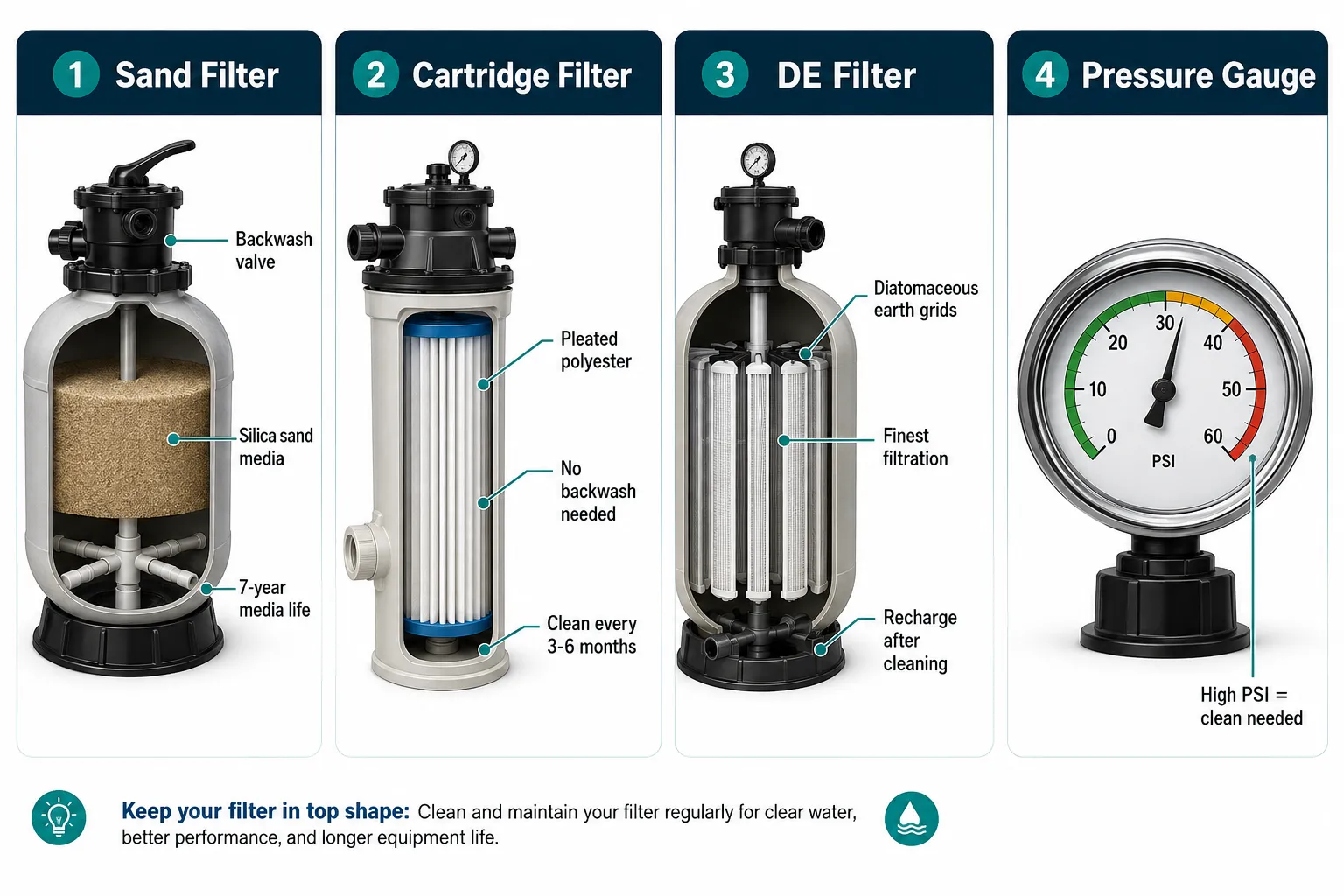
The three main filter types are sand, cartridge, and diatomaceous earth (DE), and each suits different pool sizes and maintenance preferences.
| Filter Type | Best For | Filtration Level | Maintenance |
|---|---|---|---|
| Sand | Large pools, low-maintenance owners | 20-40 microns | Backwash weekly; replace sand every 5-7 years |
| Cartridge | Small to mid-size pools, water conservation | 10-15 microns | Rinse and soak every 3-6 months; no backwash |
| DE (Diatomaceous Earth) | Pools needing the clearest water | 2-5 microns | Backwash plus DE recharge; grid cleaning annually |
No Excuses Pool services all three filter types, noting that each requires a distinct cleaning and recharge procedure [5].
Why Is My Pool Filter Pressure Too High
High filter pressure almost always means the filter media is clogged and needs cleaning. A pressure gauge reading 8 to 10 PSI above your clean baseline is the standard threshold for service.
Other causes include:
- A closed or partially closed return valve
- A blockage in the return plumbing
- Algae bloom that has rapidly loaded the filter
- Calcium scale buildup on cartridge pleats or DE grids (requires chemical soak, not just rinsing)
Edge case: If pressure spikes immediately after a cleaning, suspect a water chemistry issue. High calcium hardness or a pH above 7.8 accelerates scale formation on filter media. Balancing your water chemistry, pH 7.2 to 7.6, total alkalinity 80 to 120 ppm, calcium hardness 200 to 400 ppm, protects the filter between cleanings.
How to Clean a Pool Filter Cartridge Step by Step
Cartridge filter cleaning takes 30 to 60 minutes of hands-on work plus an overnight chemical soak for heavy buildup. Pool Time Riverside outlines a five-step professional process that homeowners can adapt for DIY use [4].
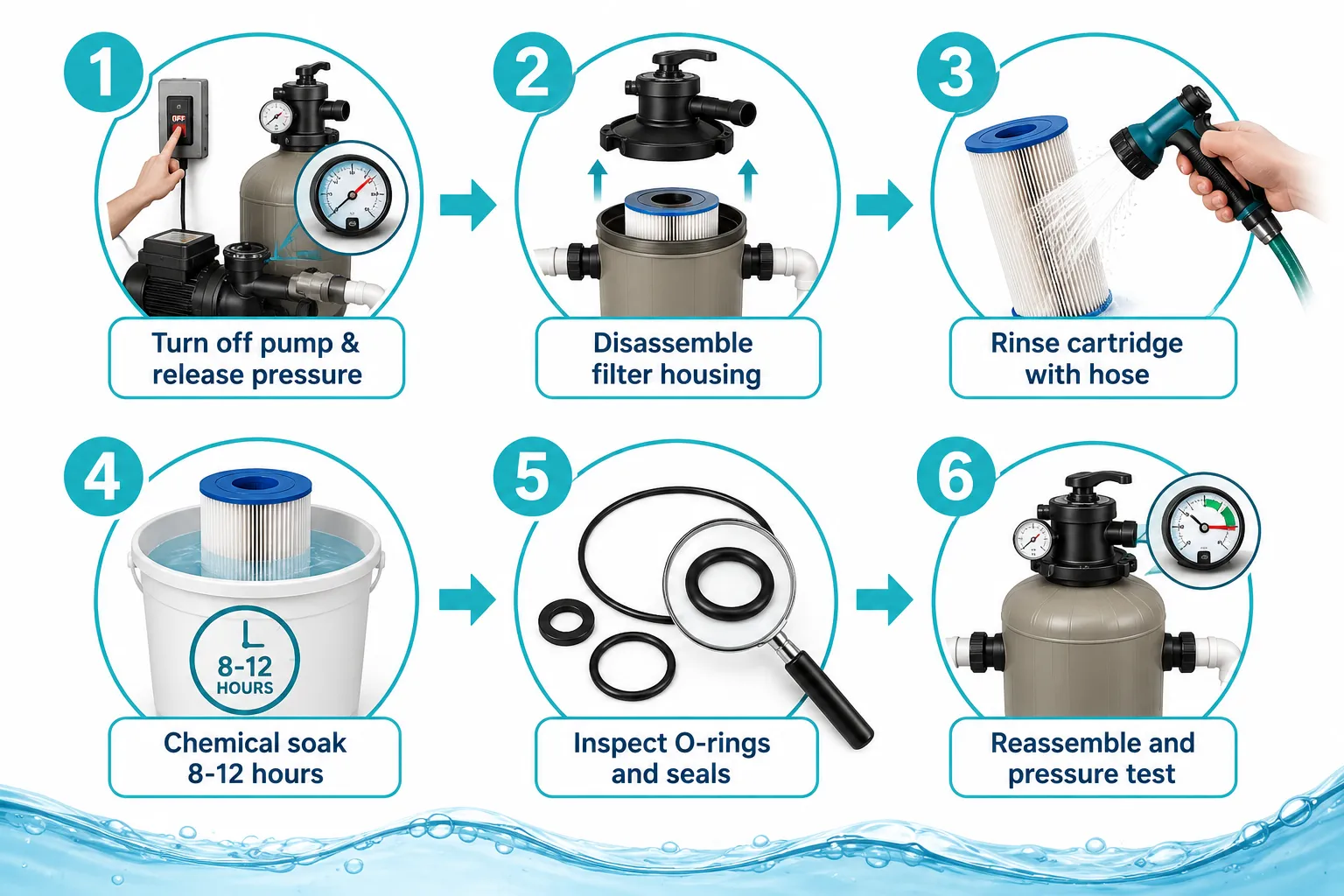
- Turn off the pump and release all pressure by opening the air relief valve on top of the filter.
- Disassemble the filter housing by removing the clamp band or bolts and lifting off the top.
- Rinse the cartridge with a garden hose, working from top to bottom between the pleats. Do not use a pressure washer, it damages the pleats.
- Chemical soak for calcium scale or heavy oil buildup: submerge the cartridge in a filter cleaning solution for 8 to 12 hours (or overnight), then rinse thoroughly.
- Inspect O-rings, seals, and the pressure gauge before reassembly. Barbosa Pool and Spa emphasizes inspecting each component individually during this step [3].
- Reassemble and start the pump. Record the clean baseline pressure on the gauge for future reference.
How Much Does It Cost to Replace or Clean a Pool Filter
Professional filter cleaning in the Riverside area typically runs $75 to $90 per visit. FiltersFresh charges a $75 flat rate for cartridge, DE, or sand filter cleaning with no upsells [12]. Riverside Pool and Spa (Ontario, Canada) publishes cartridge filter cleaning at $90 + HST as a reference point for transparent pricing [6].
For replacement parts:
- Cartridge filter elements: roughly $50 to $200 depending on brand and size
- Complete cartridge filter system (installed): approximately $300 to $600
- Complete DE or sand filter system (installed): approximately $500 to $900 or more
Is it cheaper to clean or replace? Almost always cheaper to clean, unless the element is physically damaged or cleaning no longer restores pressure. A $75 cleaning versus a $150 cartridge replacement makes the math straightforward for most homeowners.
Can IntelliCenter Monitor Filter Pressure Remotely
Yes. Pentair IntelliCenter, when paired with a compatible pressure sensor, displays filter pressure data in the IntelliCenter app and can trigger alerts when pressure exceeds a set threshold. This means you can check your filter status from your phone without walking out to the equipment pad.
ScreenLogic, Pentair’s earlier remote-access platform, offers similar functionality through its app interface. Both systems integrate with pool automation timers to schedule pump run times, which directly affects how quickly the filter loads up with debris.
Setting up filter pressure alerts in IntelliCenter:
- Navigate to Settings > Notifications in the IntelliCenter app
- Set a high-pressure alert threshold (typically clean baseline + 8 PSI)
- Enable push notifications or email alerts
Does ScreenLogic Send Alerts When the Filter Needs Cleaning
ScreenLogic can send filter-related alerts if a pressure sensor is installed and configured in the system. Without a sensor, ScreenLogic monitors runtime and system status but cannot independently detect filter pressure.
Poolwerx Riverside’s certified technicians work with automation systems including chlorinators and filters, and can configure alert thresholds during a service visit [11].
How Pool Automation Timers Help Prevent Filter Damage
Pool automation timers protect filters by ensuring the pump never runs dry and by distributing runtime to avoid overloading the filter during peak debris hours. Running the pump at consistent, scheduled intervals also prevents stagnant water that accelerates algae growth, which in turn clogs filters faster.
Practical timer settings for filter health:
- Run the pump at least 8 hours per day during summer
- Schedule a second shorter cycle in the early morning to catch overnight debris before it settles
- Use IntelliCenter’s variable-speed pump scheduling to run at lower RPMs for longer periods, which is gentler on filter media
Woodcrest Pool Service notes that proper filter maintenance and pump scheduling directly reduces energy bills and prevents costly breakdowns [14].
How to Set Up Automatic Filter Cleaning Schedules with IntelliCenter
IntelliCenter does not automate the physical act of cleaning, but it can schedule backwash cycles for sand and DE filters through automated valve actuators. For cartridge filters, IntelliCenter tracks runtime hours and can alert you when a cleaning interval is due.
Steps for scheduling a DE or sand filter backwash with IntelliCenter:
- Install a valve actuator on the multiport or backwash valve
- In IntelliCenter, create a new Schedule under the Circuits menu
- Assign the backwash valve circuit to run for 2 to 3 minutes on your chosen schedule
- Add a rinse cycle (30 seconds) after the backwash to clear the laterals
Paul’s Pool Magic in Riverside offers equipment repair and setup for pumps, heaters, and filters, and can configure automation systems as part of a service call [1].
FAQ
How do I know when my pool filter needs replacing rather than cleaning?
Replace the filter element when a full chemical soak and rinse no longer restores pressure to baseline, or when you see physical damage such as torn pleats, cracked DE grids, or channeled sand media.
Can I clean my pool filter myself?
Yes, for cartridge filters. Rinse with a hose, soak the O-rings overnight in filter cleaner, and inspect them before reassembly. DE and sand filter service is more involved and benefits from professional handling.
What happens if I never clean my pool filter?
Pressure builds until flow is restricted, straining the pump motor. Water clarity drops, algae can bloom, and the pump may overheat or fail. Neglected filters also significantly shorten cartridge life.
Does pool water chemistry affect filter life?
Directly. High calcium hardness and high pH cause scale to form on filter media, making cleaning harder and reducing media lifespan. Keep pH at 7.2 to 7.6 and calcium hardness at 200 to 400 ppm.
How long does a professional filter cleaning take?
Most professional filter cleaning visits are completed in under an hour. FiltersFresh, for example, completes most jobs in under 60 minutes [12].
Can ScreenLogic control a variable-speed pump to protect the filter?
Yes. ScreenLogic integrates with Pentair variable-speed pumps and can schedule different speed programs, which controls flow rate through the filter and helps prevent pressure spikes.
What is a DE filter recharge?
After backwashing a DE filter, you must add fresh diatomaceous earth through the skimmer to coat the grids. Without recharging, the filter runs without its filtration media and water clarity suffers.
How do I find a filter repair service near Riverside, CA?
Pool Time Riverside, No Excuses Pool, Matt’s Pool Service, and Paul’s Pool Magic all offer filter repair and cleaning services in the Riverside area [1][2][5][7].
Is a free first filter cleaning a common promotion?
Some local services offer it. AQ’s Pool Service offers a free filter clean for new customers as part of an introductory package [8].
What PSI reading means my filter is clean?
Record the pressure gauge reading immediately after a cleaning and fresh startup. That number is your personal baseline. Any reading 8 to 10 PSI above that baseline signals it is time to clean again.
Conclusion
Filter repair, cleaning & replacement, combined with pool automation, smart controls, IntelliCenter, ScreenLogic, and timers, form the backbone of a well-maintained residential pool. The practical steps are straightforward: clean cartridge filters every 3 to 6 months, watch your pressure gauge rather than the calendar, and use your automation system to schedule pump cycles and receive pressure alerts before problems develop.
Your next steps:
- Check your filter pressure gauge today and record your baseline if you have not already
- Schedule a professional filter cleaning if you cannot recall the last one
- If you have IntelliCenter or ScreenLogic, configure a high-pressure alert threshold in the app
- Test and balance your pool water chemistry, pH, alkalinity, and calcium hardness, to extend filter life between cleanings
- Contact a local Riverside pool service for filter repair or a full system inspection if pressure problems persist after cleaning
A clean, properly monitored filter keeps your water clear, protects your pump, and saves money on chemicals and energy. It is one of the highest-return maintenance tasks a pool owner can prioritize.
For more tips on optimizing your equipment setup, check out our guide to maintaining a high performance pool.
Meta Title: Pool Filter Repair, Cleaning & Replacement Guide 2026
Meta Description: Learn how often to clean your pool filter, when to replace it, and how IntelliCenter and ScreenLogic automate filter monitoring. Expert tips for Riverside homeowners.
Tags: pool filter cleaning, filter repair, cartridge filter replacement, pool automation, IntelliCenter, ScreenLogic, pool timers, DE filter, sand filter, pool water chemistry, pool maintenance, Riverside pool service