Common Pool Equipment Repairs & When You Need Them
When you hear a grinding noise from your pool pump at 6 AM or notice your pool water turning cloudy despite regular maintenance, you’re facing what every pool owner in Riverside dreads—equipment failure. I’ve seen firsthand how a small malfunction can escalate into a costly repair if ignored, and I’m here to help you understand exactly when your pool equipment needs attention and what repairs you can expect.
Your pool is a complex ecosystem of mechanical components working together 24/7. Pumps, filters, heaters, and automation systems all have finite lifespans, and knowing the warning signs of failure can save you hundreds—sometimes thousands—of dollars in emergency repairs or complete replacements.
Key Takeaways
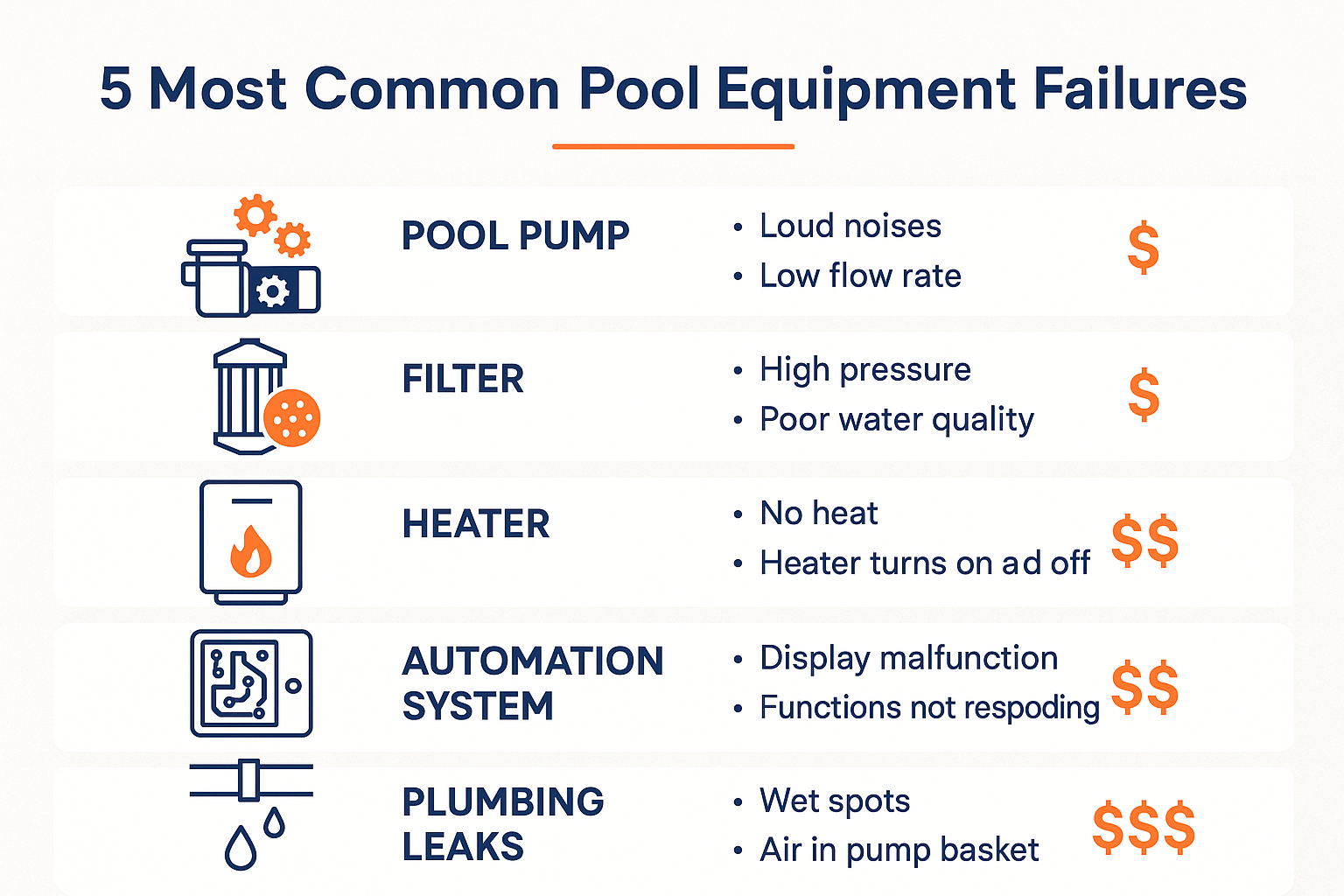
- Most pool equipment repairs fall into five categories: pump failures, filter malfunctions, heater breakdowns, automation issues, and plumbing leaks—each with distinct warning signs
- Timing matters: Catching problems early through regular inspections can reduce repair costs by 40-60% compared to emergency replacements
- Not all repairs are DIY-friendly: While some maintenance tasks are homeowner-safe, complex electrical and gas repairs require licensed professionals
- Riverside’s climate creates unique challenges: Hard water, high temperatures, and seasonal debris accelerate equipment wear in the Inland Empire
- Preventive maintenance is your best investment: Regular professional inspections and cleaning extend equipment life by 3-5 years on average
Understanding Pool Equipment and Why Repairs Matter
Pool equipment represents a significant investment in your home’s value and your family’s enjoyment. The average residential pool system includes a pump (the heart of your circulation), a filter (your water purification system), a heater (for year-round comfort), and various automation components that keep everything running smoothly.
When any of these components fail, the effects ripple through your entire pool system. A failing pump doesn’t just stop circulating water—it allows algae to bloom, chemicals to become unbalanced, and debris to settle. A malfunctioning heater means missed swim sessions and wasted energy. Equipment failures impact three critical areas: water quality, energy efficiency, and safety.
For Riverside homeowners, these concerns are amplified by our unique environmental conditions. Our hard water accelerates scale buildup on heating elements. Summer temperatures that regularly exceed 100°F put extra strain on pump motors. And our occasional Santa Ana winds dump leaves and debris that clog filters faster than in other regions.
The financial impact is real. According to industry data, emergency pool equipment repairs cost 50-75% more than scheduled maintenance and repairs. A pump that could have been repaired for $200-$300 might require a $1,200 replacement if it seizes completely. Professional pool services help you avoid these costly surprises through regular equipment inspections.
Common Pool Equipment Problems and Their Causes
Let me walk you through the most frequent equipment failures I encounter when servicing pools across Riverside and Corona. Understanding these problems helps you recognize them early.
🔧 Pool Pump Issues
Symptoms:
- Loud grinding, squealing, or humming noises
- Pump won’t prime or loses prime frequently
- Reduced water flow or pressure
- Motor runs but doesn’t circulate water
- Pump cycles on and off repeatedly
- Visible leaks around the pump housing
Common Causes:
- Worn shaft seals – The most common pump repair, typically caused by age or running the pump dry
- Damaged impeller – Debris or chemical corrosion breaks the impeller blades
- Failed capacitor or motor – Electrical components wear out after 5-8 years of continuous use
- Clogged strainer basket – Debris restricts water flow and strains the motor
- Air leaks in suction lines – Cracked O-rings or loose fittings prevent proper priming
Riverside-Specific Context: In Riverside’s hard water zones (particularly areas east of Highway 215), mineral deposits accelerate seal wear. I’ve replaced pump seals on 3-year-old equipment that should have lasted 5-7 years simply due to calcium buildup.
🌊 Filter Malfunctions
Symptoms:
- Cloudy or dirty water despite proper chemical balance
- Increased pressure gauge readings (8-10 PSI above normal)
- Decreased pressure readings (indicating internal damage)
- Sand or DE powder returning to the pool
- Visible cracks in the filter tank
- Water bypassing the filter entirely
Common Causes:
- Clogged filter media – Sand, cartridges, or DE grids become saturated with debris
- Broken laterals or grids – Internal components crack, allowing unfiltered water through
- Damaged multiport valve – Prevents proper backwashing and filtering
- Cracked tank or housing – Age, freeze damage, or excessive pressure causes structural failure
- Channeling in sand filters – Water creates paths through old sand, reducing filtration
Local Consideration: Corona and Riverside pools surrounded by eucalyptus or oak trees experience faster filter media saturation during fall months, requiring more frequent backwashing or cartridge cleaning.
🔥 Heater Breakdowns
Symptoms:
- Heater won’t ignite or stay lit
- Error codes displaying on digital controls
- Pilot light goes out repeatedly (gas heaters)
- Inadequate heating despite running continuously
- Unusual smells (gas odor or burning plastic)
- Visible corrosion or rust on heat exchanger
Common Causes:
- Failed ignition system – Pilot assemblies, igniters, or gas valves malfunction
- Scaled heat exchanger – Calcium buildup reduces heat transfer efficiency by 40-60%
- Pressure switch failures – Safety switches prevent ignition when they malfunction
- Corroded burner trays – Chemical fumes and moisture cause premature corrosion
- Thermostat calibration issues – Temperature sensors fail to accurately read water temp
Hard Water Impact: Riverside’s water hardness (typically 200-400 PPM) is particularly brutal on heaters. I’ve seen heat exchangers completely clogged with scale in just 3-4 years without proper water chemistry maintenance.
⚡ Automation and Control System Failures
Symptoms:
- System won’t respond to programming
- Equipment runs continuously or won’t turn on
- Valve actuators stuck in one position
- Salt chlorine generators showing flow errors
- Touchscreen displays frozen or blank
- Remote access features not working
Common Causes:
- Circuit board corrosion – Moisture and chemical fumes damage electronics
- Failed valve actuators – Motors that control automatic valves wear out
- Sensor malfunctions – Flow, temperature, and chemical sensors provide false readings
- Power supply issues – Transformers and power connections fail
- Software glitches – Automation systems require periodic updates and resets
💧 Plumbing Leaks and Line Damage
Symptoms:
- Visible water pooling around equipment
- Constantly dropping water level (more than normal evaporation)
- Wet spots in yard or near pool
- Hissing sounds indicating pressurized leaks
- Air bubbles in return lines
- Unusually high water bills
Common Causes:
- Cracked PVC pipes – Age, ground movement, or freeze damage
- Failed O-rings and gaskets – Rubber seals deteriorate over time
- Loose threaded connections – Vibration causes fittings to loosen
- Underground line breaks – Tree roots or ground settling damage buried pipes
- Pump union failures – Connection points between pump and plumbing develop cracks
Diagnosis: How to Identify Equipment Problems
As a pool owner, you can perform basic diagnostics before calling for professional pool repair services. Here’s my step-by-step approach to identifying common equipment issues.
Visual Inspection Checklist
Weekly Walk-Around (5 minutes):
- ✅ Check for visible leaks around pump, filter, and heater
- ✅ Listen for unusual noises when equipment is running
- ✅ Verify pressure gauge readings (note your normal baseline)
- ✅ Inspect for corrosion, rust, or damaged components
- ✅ Look for error codes or warning lights on digital displays
Monthly Deep Inspection (15 minutes):
- ✅ Open pump strainer basket and check for debris
- ✅ Examine all visible O-rings for cracks or compression
- ✅ Test all valves for smooth operation
- ✅ Check electrical connections for corrosion
- ✅ Verify timer settings and automation programming
Diagnostic Testing by Equipment Type
Pump Diagnostics:
- Prime Test – Turn off pump, open strainer lid, fill with water, restart. If it loses prime within 5 minutes, you have an air leak.
- Noise Assessment – Grinding = bad bearings; humming without running = capacitor failure; squealing = shaft seal wear
- Flow Test – Weak return jets despite clean filter indicate impeller damage or suction blockage
- Amperage Check – Use a clamp meter to verify motor draws correct amperage (consult equipment label)
Filter Diagnostics:
- Pressure Test – Normal operating pressure is 8-15 PSI for most residential filters. Add 8-10 PSI = time to clean; subtract 5+ PSI = internal damage
- Water Clarity Test – If water remains cloudy after 24 hours of filtering with balanced chemistry, filter isn’t working properly
- Backwash Observation – Cloudy water should clear within 2-3 minutes of backwashing. If it stays dirty, media needs replacement
- Visual Media Check – For cartridge filters, remove and inspect for tears, compressed pleats, or permanent staining
Heater Diagnostics:
- Ignition Sequence – Time how long heater takes to ignite (should be under 30 seconds). Delayed ignition indicates problems
- Temperature Rise Test – Measure water temp entering and exiting heater. Should see 1-3°F increase per pass
- Exhaust Inspection – Look for excessive condensation, rust stains, or soot around exhaust vent
- Flame Pattern – Gas heaters should show even blue flames. Yellow flames or uneven patterns indicate burner issues
When to DIY vs. When to Call a Professional
Safe DIY Tasks:
- 🟢 Cleaning pump strainer baskets
- 🟢 Backwashing sand or DE filters
- 🟢 Cleaning or replacing cartridge filters
- 🟢 Resetting circuit breakers or GFCI outlets
- 🟢 Adjusting timer settings
- 🟢 Replacing simple O-rings and gaskets
- 🟢 Clearing minor debris from skimmers
Call a Professional For:
- 🔴 Any gas line work or heater repairs (safety and permit requirements)
- 🔴 Electrical repairs beyond simple breaker resets
- 🔴 Pump motor replacement or internal pump repairs
- 🔴 Underground plumbing leak detection and repair
- 🔴 Filter tank repairs or media replacement
- 🔴 Automation system troubleshooting and programming
- 🔴 Anything involving chemical feeders or chlorine generators
Why Professional Diagnosis Matters: I’ve responded to countless “emergency” calls where homeowners attempted DIY repairs that made problems worse. A misdiagnosed pump issue led one Corona homeowner to replace a $400 motor when the actual problem was a $12 capacitor. Another tried to fix a heater and created a gas leak that required immediate professional intervention.
Licensed pool technicians have diagnostic tools—multimeters, pressure gauges, leak detection equipment, and manufacturer-specific knowledge—that identify root causes quickly. Riverside Pool Repair’s team offers free equipment inspections that can save you from costly misdiagnoses.
Pool Equipment Repair vs. Replacement Options
Once you’ve identified a problem, you face a critical decision: repair or replace? Here’s how I help homeowners make that choice.
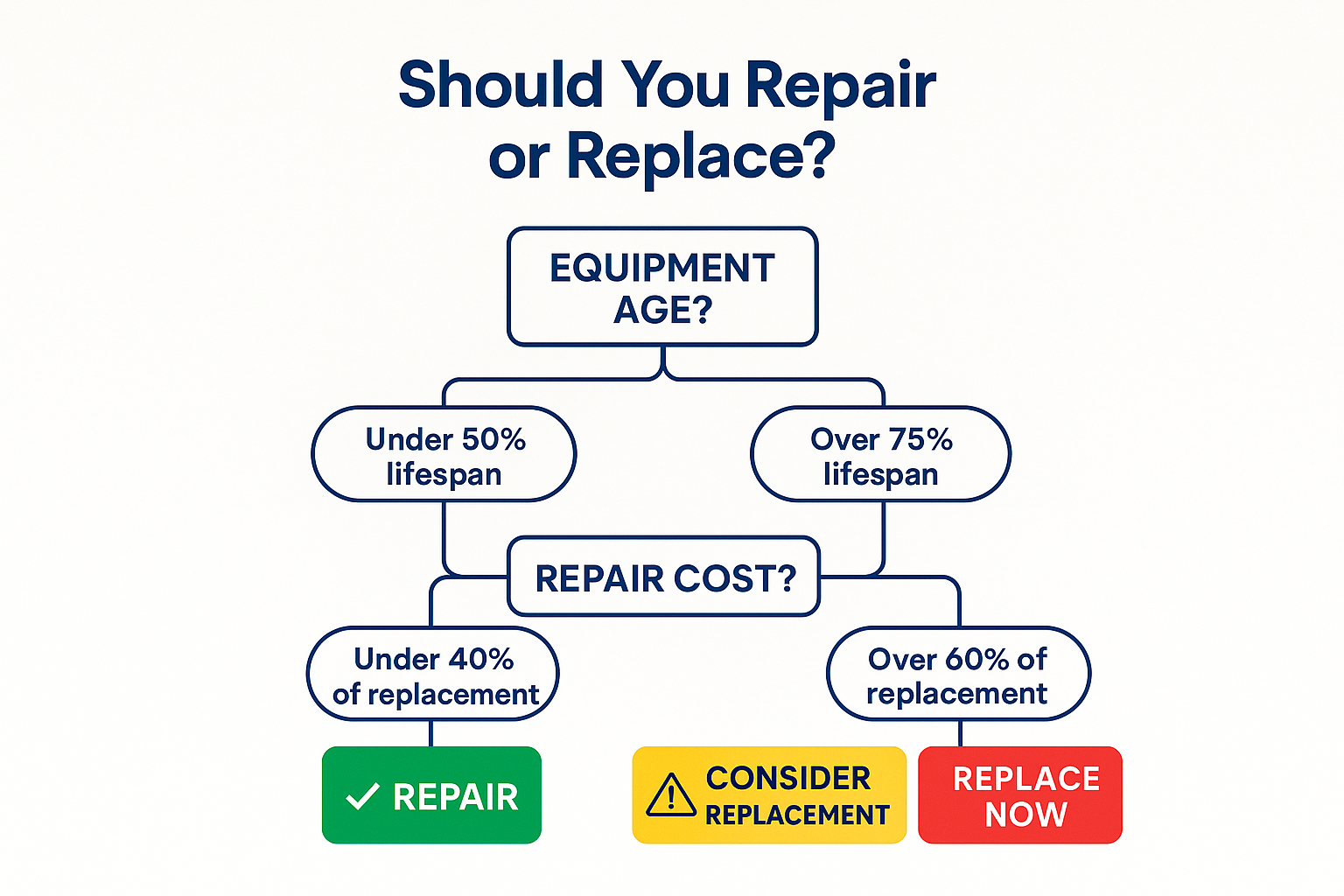
Cost-Benefit Analysis Framework
Repair Makes Sense When:
- Equipment is less than 50% through its expected lifespan
- Repair cost is less than 40% of replacement cost
- Only one component has failed (not multiple systems)
- Replacement parts are readily available
- Energy efficiency isn’t significantly compromised
Replacement Makes Sense When:
- Equipment is past 75% of expected lifespan
- Repair costs exceed 60% of replacement cost
- Multiple failures have occurred within 12 months
- New equipment offers 30%+ energy savings
- Manufacturer no longer supports parts
Typical Repair Costs and Timeframes (2025 Riverside Market)
| Equipment | Common Repair | Cost Range | Time Required | Replacement Cost |
|---|---|---|---|---|
| Pool Pump | Shaft seal replacement | $150-$300 | 1-2 hours | $2500 |
| Pool Pump | Motor replacement | $300-$600 | 2-3 hours | $2500 |
| Pool Pump | Capacitor replacement | $75-$150 | 30-60 minutes | $2500 |
| Sand Filter | Media replacement | $200-$400 | 2-3 hours | $500-$1,200 |
| Sand Filter | Multiport valve | $150-$350 | 1-2 hours | $500-$1,200 |
| Cartridge Filter | New cartridges | $300-$400 | 30 minutes | $400-$900 |
| Gas Heater | Ignition system | $200-$500 | 1-2 hours | $2,500-$5,000 |
| Gas Heater | Heat exchanger | $800-$1,500 | 3-4 hours | $5,000 |
| Heat Pump | Compressor | $1,200-$2,000 | 4-6 hours | $3,500-$6,500 |
| Automation | Circuit board | $250-$600 | 1-2 hours | $1200-$2,500 |
| Salt System | Cell replacement | $400-$800 | 1 hour | $1,200-$2,500 |
Emergency vs. Scheduled Pricing: Emergency after-hours repairs typically add 50-100% to these costs. Weekend and holiday service commands premium pricing. Scheduling repairs during normal business hours saves significantly.
Quick Fixes vs. Permanent Solutions
Some repairs offer temporary relief while you budget for proper fixes:
Temporary Measures:
- Leaking pump seal – Tighten bolts and monitor daily (buys 1-4 weeks)
- Noisy bearings – Reduce run time to essentials only (buys days to weeks)
- Clogged filter – Increase cleaning frequency (ongoing workaround)
- Intermittent heater – Manual resets as needed (unreliable but functional)
Permanent Solutions:
- Leaking pump seal – Complete seal and bearing replacement
- Noisy bearings – Motor replacement or full pump upgrade
- Clogged filter – Media replacement and addressing root cause of debris
- Intermittent heater – Component replacement or full heater upgrade
What Riverside Pool Repair Offers
When you work with our team, you receive:
✅ Free Equipment Inspection & Quote – We diagnose the problem at no charge and provide written estimates before any work begins
✅ No Long-Term Contracts – Pay only for the repairs you need, when you need them
✅ 20+ Years Local Experience – We understand Riverside’s unique pool challenges and stock parts for common local issues
✅ Same-Day Emergency Service – Available for urgent repairs that affect water quality or safety
✅ Warranty on Parts & Labor – All repairs include manufacturer warranties plus our workmanship guarantee
✅ Energy Efficiency Upgrades – We recommend variable-speed pumps and modern equipment that reduce operating costs by 30-70%
Our approach prioritizes honest assessments. If your 12-year-old single-speed pump needs a $400 motor replacement, I’ll tell you that investing $800 in a variable-speed pump will save you $600+ annually in electricity costs. That’s a better long-term investment.
Preventive Maintenance: Extending Equipment Life
The most effective “repair” is the one you never need. Here’s my proven maintenance schedule that extends equipment life by years.
Weekly Maintenance Tasks (15 minutes)
Homeowner Responsibilities:
- 🗓️ Empty skimmer and pump baskets
- 🗓️ Check and record pressure gauge readings
- 🗓️ Test water chemistry (pH, chlorine, alkalinity)
- 🗓️ Visually inspect equipment for leaks or unusual sounds
- 🗓️ Verify timer and automation settings
Why It Matters: A clogged pump basket forces your motor to work 20-30% harder, reducing its lifespan by years. Weekly basket cleaning is the single most impactful task you can perform.
Monthly Maintenance Tasks (30-45 minutes)
Homeowner or Professional:
- 🗓️ Clean or backwash filter (based on pressure readings)
- 🗓️ Lubricate O-rings with silicone-based lubricant
- 🗓️ Inspect and clean salt cell (if applicable)
- 🗓️ Check for signs of corrosion on electrical connections
- 🗓️ Test GFCI outlets and circuit breakers
- 🗓️ Verify all valves operate smoothly
Seasonal Maintenance (Quarterly)
Spring (March-April):
- Deep clean filter media or replace cartridges
- Inspect heater before heavy use season
- Check for winter damage to plumbing and equipment
- Calibrate automation and chemical feeders
- Test all safety equipment
Summer (June-July):
- Monitor equipment for heat-stress issues
- Increase filter cleaning frequency due to higher use
- Inspect pump for bearing wear (heavy use reveals problems)
- Verify adequate ventilation around equipment
Fall (September-October):
- Prepare for reduced use season
- Adjust timer settings for shorter run times
- Clean leaves and debris before they clog systems
- Inspect for summer wear and tear
Winter (December-January):
- Protect equipment from freeze damage (rare but possible in Riverside)
- Reduce chemical feeder settings for lower use
- Consider heater service before cold snaps
- Check for rain-related equipment issues
Annual Professional Inspection
Even with diligent homeowner maintenance, annual professional inspections catch problems early. During our comprehensive service, we:
- Electrical System Check – Test voltage, amperage, and all connections
- Pressure Testing – Verify system holds pressure and identify hidden leaks
- Equipment Efficiency Analysis – Measure actual performance against specifications
- Water Chemistry Deep Dive – Test for metals, TDS, and other factors affecting equipment
- Predictive Maintenance – Identify components approaching end-of-life before they fail
Investment vs. Savings: A $150-$200 annual inspection typically identifies $500-$1,000 in potential emergency repairs that can be scheduled during off-season at lower costs.
Riverside-Specific Maintenance Considerations
Hard Water Management:
- Use sequestering agents monthly to prevent scale buildup
- Drain and acid-wash heater heat exchangers every 2-3 years
- Replace sacrificial anode rods in heaters annually
- Consider salt water conversion to reduce calcium scaling
Debris Control:
- Install secondary strainer baskets during fall leaf season
- Increase skimming frequency during Santa Ana wind events
- Trim trees and vegetation around pool area
- Use pool covers during extended non-use periods
Heat Stress Prevention:
- Ensure adequate shade and ventilation for equipment pad
- Consider fan-assisted cooling for enclosed equipment areas
- Monitor motor temperatures during 100°F+ days
- Reduce unnecessary run time during peak heat hours
For a comprehensive maintenance checklist, visit our blog resources where we share seasonal guides specific to Inland Empire pool care.
Frequently Asked Questions About Pool Equipment Repairs
How do I know if my pool pump needs repair or replacement?
Listen and observe. If your pump is making grinding, squealing, or loud humming noises, it needs attention. A pump that won’t prime, leaks water, or cycles on and off repeatedly is signaling failure. For pumps less than 8 years old, repairs often make sense—particularly seal replacements ($150-$300) or capacitor swaps ($75-$150). However, if your pump is 10+ years old or requires a motor replacement, investing in a modern variable-speed pump saves money long-term through 50-70% lower energy costs.
What’s the average lifespan of pool equipment in Riverside?
Equipment lifespans vary significantly based on maintenance and local conditions:
- Pool pumps: 8-12 years (variable-speed models often last longer)
- Filters: 10-15 years for tanks; media requires replacement every 3-7 years
- Gas heaters: 7-10 years in hard water areas (can reach 12-15 with excellent maintenance)
- Heat pumps: 10-15 years
- Salt systems: 5-7 years for cells; control boards 7-10 years
- Automation systems: 8-12 years
Riverside’s hard water and high temperatures reduce these averages by 15-20% compared to ideal conditions. Regular professional maintenance extends lifespans significantly.
Can I run my pool if the heater is broken?
Yes, absolutely. Your pool can operate normally without a functioning heater—you simply won’t have temperature control. The heater is a separate component from your circulation system. However, if your heater is showing error codes or won’t shut off, turn off the heater breaker and contact a professional. Never ignore gas odors or unusual heater behavior, as these pose safety risks. Schedule a heater inspection to diagnose the issue and determine if repair or replacement is needed.
How often should pool filters be cleaned or replaced?
Cleaning frequency depends on filter type and pool usage:
- Sand filters: Backwash when pressure rises 8-10 PSI above baseline (typically every 2-4 weeks); replace sand every 5-7 years
- Cartridge filters: Rinse every 2-4 weeks; deep clean quarterly; replace cartridges every 1-3 years
- DE filters: Backwash and recharge every 4-8 weeks; replace grids every 5-8 years
Riverside pools surrounded by trees, experiencing heavy use, or dealing with algae issues need more frequent cleaning. Monitor your pressure gauge—it tells you exactly when cleaning is needed.
What causes pool equipment to fail prematurely?
The top five causes I see in Riverside:
- Poor water chemistry – Imbalanced pH and alkalinity corrode metal components and degrade seals
- Running equipment dry – Pumps without water overheat and destroy seals and bearings within minutes
- Inadequate maintenance – Clogged baskets and filters force equipment to work harder, reducing lifespan by years
- Electrical issues – Voltage fluctuations, inadequate grounding, and poor connections damage motors and circuit boards
- Hard water neglect – Riverside’s mineral-heavy water scales heaters and clogs salt cells without proper treatment
Prevention is straightforward: Maintain proper water chemistry, clean baskets weekly, schedule annual professional inspections, and address small problems before they escalate.
Should I upgrade to energy-efficient equipment during repairs?
In most cases, yes—especially for pumps. If your single-speed pump needs major repairs and is 7+ years old, upgrading to a variable-speed pump is a smart investment. Here’s why:
- Energy savings: Variable-speed pumps use 50-70% less electricity ($600-$900 annual savings in Riverside)
- Payback period: Equipment pays for itself in 2-3 years through reduced utility bills
- Rebates available: Many utilities offer $200-$400 rebates for variable-speed pump installations
- Quieter operation: Modern pumps run significantly quieter than older models
- Longer lifespan: Variable-speed motors typically last 12-15 years vs. 8-10 for single-speed
For heaters, heat pumps offer excellent efficiency in Riverside’s climate, though they have higher upfront costs than gas heaters. Our team can calculate your specific payback period based on current equipment and usage patterns.
Interactive Pool Equipment Repair Decision Tool
🔧 Repair or Replace Calculator
Get instant guidance on whether to repair or replace your pool equipment
Take Action: Professional Pool Equipment Repairs in Riverside
When your pool equipment shows signs of trouble, quick action prevents minor issues from becoming major expenses. Whether you’re hearing strange noises from your pump, noticing declining water quality, or dealing with a heater that won’t ignite, professional diagnosis is your first step.
Why Choose Riverside Pool Repair?
🏆 Over 20 Years of Inland Empire Expertise – We’ve serviced thousands of pools across Riverside, Corona, and surrounding communities. We understand the unique challenges our hard water, high temperatures, and seasonal conditions create for pool equipment.
💰 No Contracts, No Pressure – You pay only for the services you need. We provide transparent pricing, written estimates, and honest recommendations about repair vs. replacement decisions.
⚡ Fast, Reliable Service – We offer same-day emergency repairs for urgent issues and convenient scheduling for routine maintenance and planned repairs.
✅ Quality Parts & Warranties – All repairs include manufacturer warranties on parts plus our workmanship guarantee. We stock common replacement parts for faster service.
🎓 Educated Recommendations – We don’t just fix problems—we explain them. You’ll understand what failed, why it happened, and how to prevent future issues.
Ready to Get Started?
Don’t let equipment problems ruin your pool season or drain your wallet through emergency repairs. Here’s how to connect with us:
📞 Call for Immediate Assistance – Speak directly with an experienced technician who can diagnose problems over the phone and schedule service
📧 Request a Free Quote – Fill out our simple form describing your equipment issue and receive a detailed estimate
🌐 Explore Our Services – Learn about our complete range of pool maintenance, repair, and upgrade services
📱 Schedule Your Annual Inspection – Preventive maintenance appointments available throughout the year
Service Areas We Cover
We proudly serve residential pool owners throughout:
- Riverside (all ZIP codes)
- Corona
- Norco
- Jurupa Valley
- Eastvale
- Moreno Valley
- And surrounding Inland Empire communities
What Happens Next?
- Contact us via phone, email, or our online form
- Describe your equipment issue – We’ll ask targeted questions to understand the problem
- Schedule a convenient inspection – Often same-day or next-day availability
- Receive a written estimate – Clear pricing before any work begins
- Approve the repair – No work starts without your authorization
- Get back to enjoying your pool – Most repairs completed in one visit
Additional Resources
Continue learning about pool care and maintenance:
- Weekly Pool Service – Professional maintenance prevents equipment problems
- Pool & Spa Repair Services – Complete repair solutions for all equipment types
- Salt Water Pool Systems – Modern alternatives that reduce equipment wear
- Pool Care Blog – Tips, guides, and seasonal advice for Riverside pool owners
Your pool represents a significant investment in your home and lifestyle. Protecting that investment through timely equipment repairs and professional maintenance ensures years of reliable enjoyment. Whether you need emergency repairs today or want to schedule preventive maintenance, our team is ready to help.
Don’t wait for small problems to become expensive emergencies. Contact Riverside Pool Repair today for expert equipment diagnosis and repair.